
High-Temperature Heat Pumps Must Become the Low-Risk Choice

This article is a takeaway from the HTHP Symposium 2026 and offers insight into how manufacturers are redesigning core components like compressors to ensure reliable, long-term operation under demanding industrial conditions.
More and more high-temperature heat pumps are now reaching market maturity, while suppliers are continuing to develop the technology further in order to accelerate the uptake of new high-temperature solutions.
A total of 37 companies and suppliers exhibited at HTHP Symposium 2026 at the Bella Centre in Copenhagen. This is a record and a significant increase compared with the previous symposium in 2024. The exhibitors included both established industrial players and smaller suppliers, including several start-ups which see strong potential in the emerging market for high-temperature heat pumps.
- The growing number of exhibitors shows that there is now an increasing recognition of a new commercial market for high-temperature solutions, and we are seeing a wide variety of technological approaches aimed at meeting a broad range of application needs, said Benjamin Zühlsdorf, Innovation Director at Danish Technological Institute.
Collectively, the exhibitors point to a new phase in the market, in which not only the technologies themselves but also the supply chains are becoming more mature. It is no longer just a question of developing individual installations, but a question of making solutions reproducible and scalable across industries and applications.
From heat pump supplier Frascold came the message that the market could become significantly larger than it is today:
- A market ten times larger than today lies ahead, so there is room for everyone wanting to enter the sector, including the new start-ups, said Kaven Nourrice of Frascold during his presentation at the symposium.
Frascold is one of the suppliers now fully engaged in further development work, including the design of new bespoke compressors that will initially be able to deliver temperatures of 140 °C, but in time could lead to solutions capable of reaching 200 °C.
However, the development is not only about how high temperatures the technologies can deliver. Increasingly, it is also about how quickly these solutions can be commercialised, standardised, and rolled out more widely.

A record number of exhibitors showcased their technology at this year's symposium.
Much-needed reassurance
Standardisation is a sign of a high level of market maturity, and for now it appears that standardisation will initially cover systems operating up to 120 °C to 130 °C. Above these temperatures, installations are still largely tailormade or demonstration units, said Martin Pihl Andersen of Danish Technological Institute, citing the IEA HPT Project 68, which tracks the global deployment of high-temperature heat pumps.
A range of different technologies has found its place in the market, including vapour compression as well as Stirling and gas cycles. Industrial applications vary so widely in terms of temperature requirements, heat sources, temperature lift, and capacity that different solutions are needed when it comes to both processes and refrigerants.
- We are now seeing more suppliers coming forward with components for high-temperature systems, making it possible for a growing number of system builders to deliver HTHP installations. The next natural step is to establish service networks of the kind we know from the refrigeration industry, said Benjamin Zühlsdorf.
For industrial customers, the investment decision depends largely on whether the solution can be supported over time and whether the necessary expertise is available for operation, maintenance, and troubleshooting. According to supplier Bitzer, the shift to high-temperature heat pumps represents a major step for customers:
- Many companies currently use gas boilers for high-temperature processes and are comfortable with them. We need to offer the same reassurance with high-temperature heat pumps. But customers do not want to take on too much risk all at once, so they move forward step by step. This can, for example, relate to the refrigerants they want to use, even though we are developing our technology for natural refrigerants and recommend them, said Cyril Beaussart from Bitzer.
Bitzer’s immediate goal is to be able to deliver solutions operating at up to 160 °C. These may include cascade systems and MVR-based solutions. At the same time, Bitzer is continuing its work on component development and compressor testing.
- There also needs to be enhanced customer support for new HTHP users, so that high-temperature solutions do not develop a poor reputation. We need to deliver systems that can operate safely and reliably for 10 years, so that customers do not come to regret their decision. That is not only our task and responsibility, but that of the industry as a whole, said Cyril Beaussart.

Crucial compressor development
High-temperature heat pumps operate under far more demanding conditions than heat pumps delivering heat below 100 °C. Compressors are particularly critical as they must be designed for continuous, long-term operation at very high temperatures. If the market is to scale up, it will require robust compressors that can be manufactured, integrated and serviced on a much broader basis.
At the symposium, several heat pump manufacturers described the development work under way to deliver reliable high-temperature solutions. At the Italian manufacturer Dorin, particular attention has been paid to the compressor itself, which is exposed to new types of stress when systems are required to deliver sustained temperatures of up to 180 °C.
- High temperatures affect the oil and lubrication system. We have had to redesign our compressors from the ground up in order to prevent oil from spreading throughout the system and thereby causing rapid wear of the mechanical components, said Giacomo Pisano of Dorin.
- We want to supply compressors for natural refrigerants, and through development and testing we have arrived at a new robust design capable of delivering temperatures of up to 180 °C, he said at the symposium.
The pharmaceutical industry is among the sectors that already feel sufficiently confident to integrate high-temperature heat pumps.
GE Healthcare, for example, has integrated a solution from Enerin at its Norwegian site producing contrast media. The system is based on Stirling technology using helium and is potentially capable of delivering temperatures of up to 200 °C, although in its current configuration it operates at up to 137 °C.
Another pharmaceutical application for high-temperature heat pumps was installed at Takeda in Vienna in 2025 as part of the AHEAD project. Here, waste heat from cooling processes is recovered to supply heat for, among other things, Takeda’s sterilisation processes, which require temperatures of up to 184 °C. The technical limits of the plant, however, potentially extend to 200 °C to 260 °C. This installation is also based on natural refrigerants.
These examples point to an important reality: the market is not being shaped solely by new start-up ideas or demonstration projects, but also by industrial reference cases which can help reduce perceived risk for future customers. When larger companies adopt the technology, they help to mature the market and build confidence that these solutions can perform in practice.

Presentations highlighted new compressor designs developed for demanding high temperatures.
Cost-effective decarbonisation
The symposium also showed that there are two forms of maturity which, ideally, need to progress in step: technological maturity and commercial maturity. Even as suppliers continue to develop ever better and higher-performing systems, the right framework conditions and the underlying economics must also be in place.
- The technologies are available. Hydrocarbons are gaining ground as obvious refrigerants. Vapour compression features in many solutions. What remains is better alignment of expectations between system owners and technology suppliers. Critical data need to be shared. The integration process involves risks, and we are still waiting for standardisation to become more widespread. There is still work to be done for consultants, said Jonas Kjær Jensen from DTU in his concluding remarks.
Despite the extensive development work is still under way, the conclusion from the International Energy Agency was clear: high-temperature heat pumps are not merely a promising technology for the future, but already a relevant tool for industrial decarbonisation.
- The technologies are ready and offer immediate and cost-effective ways to decarbonise industry, said Elisa Asmelash, analyst at the IEA, at the symposium.
Viewed in the wider context of HTHP Symposium 2026, the market for high-temperature heat pumps is entering a new phase. Technology development is continuing, yet the decisive shift is on the supply side, where the market is becoming more mature. More technologies are now available commercially, components are becoming easier to source, and solutions are moving towards greater standardisation. These are precisely the developments which can make high-temperature heat pumps a dependable choice for industry.
The European Heat Pump Association closed with a call for a more holistic view of the new high-temperature solutions:
- High-temperature heat pumps are not only industrial solutions; they can also provide support to the power grid in combination with thermal and electrical storage. That is a development still waiting to be implemented. So, there is clearly scope for further dialogue, said Jozefien Vanbecelaere from EHPA.

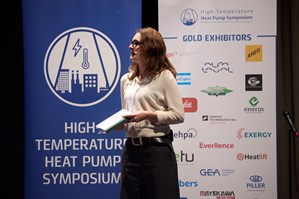
Elisa Asmelash, IEA, and Jozefien Vanbecelaere, EHPA.
_________________________________________________________________________________________
HTHP Symposium 2026
- 530 participants
- 37 exhibitors
- 78 presentations
- 45 poster presentations
- 3 sector workshops
_________________________________________________________________________________________